Asphaltene deposition is one of the most persistent flow assurance challenges in the oil and gas industry. When crude oil components interact with precipitants such as n-alkanes (e.g., n-heptane, n-pentane, propane), asphaltenes precipitate, agglomerate, and diffuse toward pipe walls—leading to deposits, clogging, and ultimately reduced production. This problem has cost the industry billions in lost output and well shut-ins.
To tackle this issue, we have developed a one of its kind, unique & custom-engineered patented Asphaltene Deposition Test Rig and Procedure for Asphaltene Deposition Analysis and Inhibitor Screening (Indian Patent No. 202221035421) capable of real pipeline conditions with precise control over flow dynamics and chemical environment.
What Makes Our Rig Unique?
Unlike traditional shear cells that oversimplify the fluid dynamics, our test rig uses true pipe geometry to accurately simulate the velocity profiles and shear stress distribution found in actual pipelines. This is crucial for studying the behavior of asphaltene particles during precipitation, agglomeration, and deposition under laminar, transitional, and turbulent flow regimes.
Both capillary and rig-scale studies are essential for understanding asphaltene deposition, but rig-scale studies provide a more realistic representation of field conditions. Like:
| Capillary Study | Rig-scale study |
| Uses small-diameter tubes (e.g., 250–1500 µm) to study deposition at a microscopic level and does not fully replicate actual flow conditions in pipelines. | Conducted on a larger, field-representative system with pipes, pumps and simulates real-world conditions (temperature, pressure, flow rates, and fluid compositions). |
| Performed under only controlled laminar flow and does not capture turbulence and multiphase flow behavior. | Can simulate turbulent, multiphase, and high-pressure flow regimes and captures effects of flow rate changes on asphaltene behavior. |
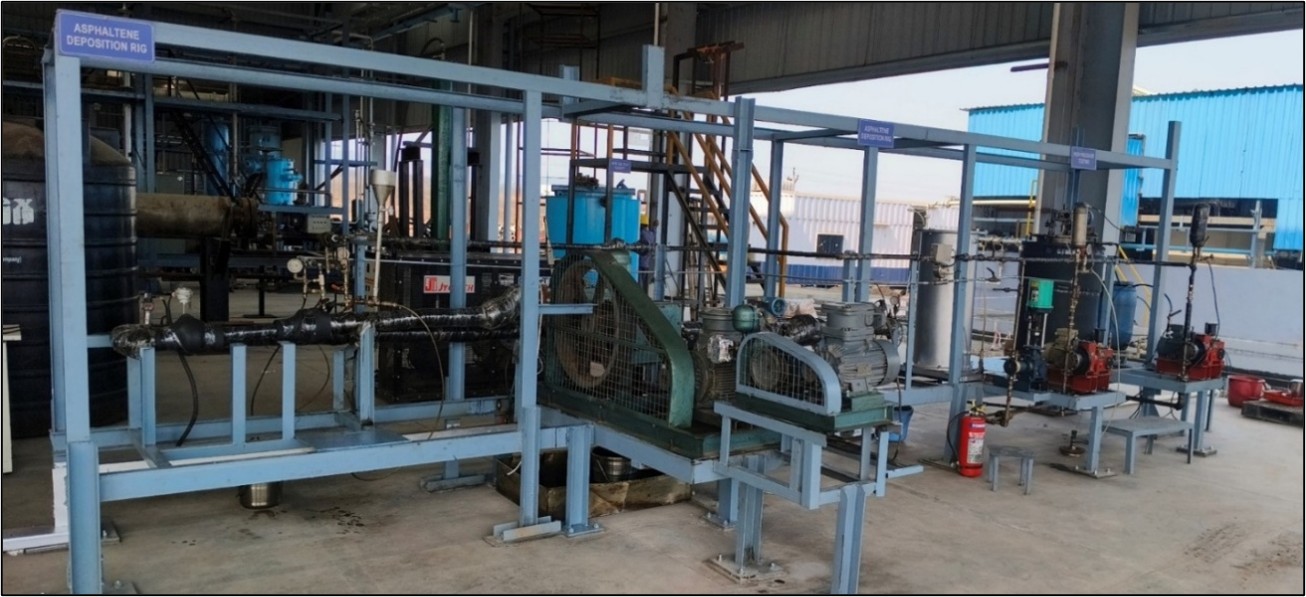
Unique Rig for Studying Asphaltene Deposition with Liquid Precipitants, Simulating Pipe Flow Conditions
Key Capabilities:
- Pressure: Up to 40 bar
- Temperature: Up to 80°C
- Residence Time: 10 to 100 minutes
- Volumetric Flow Rate: 0.1 to 4 m³/h
- Wall Shear Stress: Ranges from 5 mPa to 5 Pa (fluid-dependent)
The rig can sustain high wall shear stress and extended residence times (≥50 minutes), critical parameters that allow the formation and study of realistic asphaltene deposits. Precipitants are injected into the flow to induce particle formation and observe clogging behaviors.
Applications
- Evaluation of asphaltene inhibitors
- Studying onset conditions and deposition kinetics
- Simulating different oilfield conditions
- Scaling laboratory results to field scenarios
Our test rig offers a comprehensive, high-fidelity platform for researchers and operators to investigate, predict, and mitigate asphaltene-related flow assurance issues more effectively than ever before.