


In today’s competitive chemical industry, maximizing reactor performance while minimizing operational costs is critical. Packed bed reactors form the backbone of key processes such as steam reforming, catalytic cracking, hydrogenation, and gas absorption—where catalyst efficiency directly impacts productivity and profitability.
Introduction:
Packed bed reactors are inherently complex systems. When the tube-to-particle diameter ratio is low (< 10), the heterogeneous nature of the packing significantly influences fluid flow, heat and mass transfer, and overall reaction efficiency. Catalyst particle size and shape play a decisive role in determining pressure drop, conversion rates, and ultimately reactor economics. However, experimental evaluation of these effects is time-consuming, costly, and often limited in the level of insight it can provide. By leveraging state-of-the-art Computational Fluid Dynamics (CFD) coupled with the Discrete Element Method (DEM), we can reconstruct realistic packed-bed structures with high geometric fidelity. This integrated approach enables detailed, particle-scale visualization of flow and transport phenomena—revealing mechanisms that are extremely difficult or impossible to access through experiments alone.
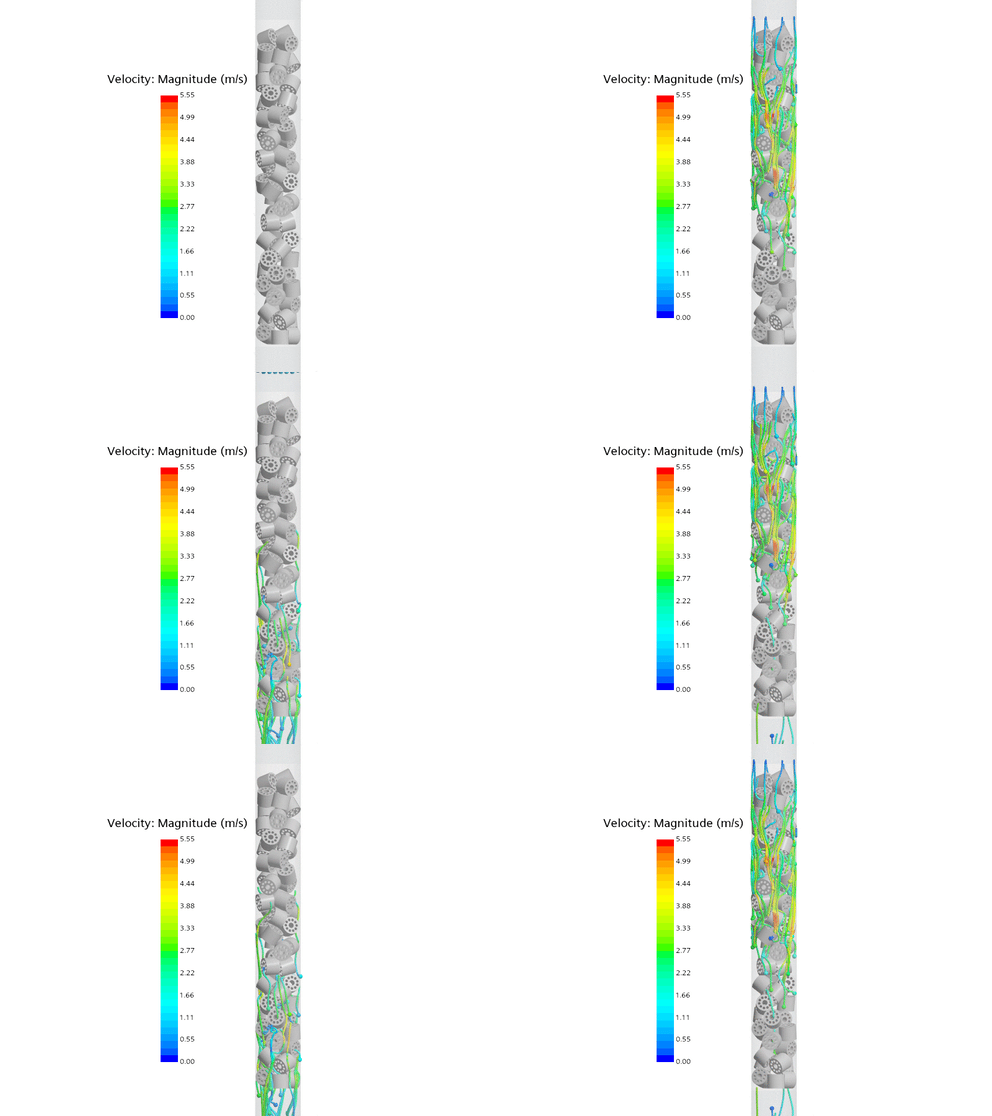 In this case study, we demonstrate how advanced simulation-driven design can optimize catalyst particle shape for steam reforming applications. The result is improved reactor efficiency, enhanced catalyst utilization, reduced pressure losses, and increased operational reliability—delivering measurable value to chemical manufacturers.
Related Use Cases

Use Cases
Checking Residual Stress Elimination after Post Weld Heat Treatment
.webp?length=400&name=Storage%20Tank%20(1).webp)
Use Cases
Liquid Flashing and Vibration in Storage Tank Feed Pipes
Use Cases
CFD modelling of Drug Release through Stent
.webp?length=400&name=Gas%20Plant%20(1).webp)
Use Cases
Assessment of FCC stripper vessel as per ASME SecVIII Div-2 code